Tuesday, February 27, 2018

Samayapuram Mariamman Temple, Samayapuram – The Temple

Samayapuram Mariamman Temple, Samayapuram – The Temple
The main deity, Samayapurathal or Mariamman, a form of supreme mother goddess Durga or Maha Kali or Aadi Shakthi, is made of sand and clay like many of the traditional Mariamman deities, and hence unlike many other Hindu deities there are no Abhishekams (sacred washing) conducted to the main deity, but instead the "abishekam" is done to the small stone statue in front of it. Mother of all Mothers, Samayapurathal is a very powerful goddess Who fulfils the heartfelt prayers of her devotees.


Mariamman is seen in a Grand, Majestic sitting posture with the Serpent Lord providing her cover over her head. Mariamman is seen with 8 hands, a special feature at this temple and holds all the weapons that Lord Shiva normally possesses. After destroying the evil forces, she adorned herself with the garland. Her left leg is seen folded with her right leg placed down on the ground in a posture of killing three Asuras. 


In ancient times, Amman was seen with wild teeth. However, in one of the Kumbabishekam during the last century this was changed to normal teeth featuring her as a ‘Shantha Swaroopi’ and with a beautiful smiling face.


Only in a very few temples, you are able to see the presiding deity from the entrance of the temple itself. Samayapurathu Mariyamman can be seen even from the main entrance of the Temple and it will look like that the Mother has been waiting for your arrival all along. This temple has separate shrines for the processional image of Mariamman and the moolavar in the sanctum. There is also a shrine to Karuppanna Saami a local deity. The associated temple named Ujjaini Om Kaliyamman at Magalikudi lies at 500 m.


Sakthi Theertham is the sub river of River Cauvery. It is also called as Peruvalai Vaaikal / Punitha Sakthi Theertham. It situated in south side of South Car street. Mahamayee Theertham is situated to north west side of Samayapuram Mariamman temple and left side to Samayapuram, near Thiruchi-Chennai highway. This Theertham is used for Theppotsavam Festival.


Jadayu Theertham is situated to the south side of Kanaga Ambikai Udanurai Muktheeswarar Temple and to the South-East side of Mariamman Temple. This Theertham is related to the epic of Ramayana. God give mukthi to Jadayu in this place. Ganga Theertham is located near to the eastern side of Ujjaini Ohm Kaliyamman Temple (Sub temple of Mariamman Temple) and to the south-east side of Mariamman Temple.


As per Vikramaditya prayer, River Ganga Devi appeared here. This Theertham is used for Vikramaditya’s Kaali Pooja. This is the most powerful Theertham to rectify diseases, phycological disorders. Vembu (Neem) Tree is Sthala Vriksham for this Temple. The beautiful idol of Aayiram Kannudayal came out from the anthill under this tree. Now she is housed in front of this Tree.


Persons affected by Chickenpox and Smallpox come to this place, stay here and pray the Goddess for speedy recovery. Abisheka Theertham (Divine Water) is sprinkled on them after Pooja and they get recovered very quickly. There is a separate rest hall for their stay in the temple. Originally the temple was under the management of the Tiruvanaikaval Temple, a popular temple in Trichy. Later, the control was split and currently Samayapuram has been placed directly under an independent trust monitored by the Government. 


Samavedeeswarar Temple, Thirumangalam, Trichy

Samavedeeswarar Temple, Thirumangalam, Trichy
Samavedeeswarar Temple is a Hindu Temple dedicated to Lord Shiva located at Thirumangalam in Trichy District of Tamilnadu. Presiding Deity is called as Sama Vedeeswarar and Mother is called as Loka Nayaki. This temple is the only unique temple in the world dedicated to the Vedas especially Samaveda. The place is considered in equal sacredness to Kasi and Gaya. This ancient Chola period temple is architecturally beautiful and has many unique sculptures. This is the birth as well as the Mukthi place of Anaya Nayanar, one of the 63 Nayanmars. The temple comes under the administration of the Hindu Religious Endowment Board.


Legends
For brief details, please refer below link;
History
The stone inscriptions of the Chola period are found in this temple. Based on those inscriptions and the architectural style of the temple, we could assume that the temple must have been built or rebuilt in the 11th century CE by the Cholas. Raja Raja Chola has contributed to the development of this temple. Many stone inscriptions have been found here.
The Temple
For brief details, please refer below link;
Singers
Many hymns have been sung in praise of the Lord of the temple by Saivite Tamil saint-poets like Sundarar, Nambiyandar Nambikal and Sekkilar.
Prayers
This temple is a parihara Sthalam for Doshas incurred from neglecting ancestors as seen by Parasurama and Chandikeswara. You can get cured of ills by the Bhairavar here. You can retrieve losses by prayers to Saneeshwara here.
Connectivity
The Temple is located at about 3 Kms from Lalgudi Bus Station, 4 Kms from Lalgudi, 5 Kms from Thirumaanthurai, 20 Kms from Samayapuram, 11 Kms from Anbil, 16 Kms from Srirangam, 16 Kms from Thiruvanaikoil and 23 Kms from Trichy. Nearest Railway Stations are located at Lalgudi (5 Kms), Manthurai (5 Kms) and Trichy (27 Kms). Nearest Airport is located at Trichy (28 Kms).

Samavedeeswarar Temple, Thirumangalam – Legends

Samavedeeswarar Temple, Thirumangalam – Legends
Sama Vedeeswarar:
Veda Vyasa divided the ancient Vedic hymns into four categories and named them as Rig, Yajur, Sama and Atharva. He passed on the knowledge of those four Vedas to his four disciples. Jaimini was one of those four disciples who learnt Sama Veda from Vyasa. It is said that Jaimini interpreted Sama Veda and further classified that into multiple verses as per his interpretation in this temple. Hence, the presiding deity of the temple is named as Sama Vedeeswarar. It should be noted that no other Shiva temple is named after a Veda.
Parasurameswaram:
Parasurama had to kill his own mother due to some reasons. He came to this temple to get rid of his Matru hatya sin. Hence, the holy tank of this temple is named as Parasurama Theertham and the village is also called as Parasurameswaram.
Thirumangalam:
Lakshmi worshiped Shiva in this temple. Hence, the village is called as Thirumangalam.
Equivalent to Gaya & Kashi:
Ravikuruva Rishi, a lesser known sage, wanted to attain liberation and came to this village. As he could not find a river nearby, he decided to go to Gaya and Kasi. Lord Shiva stopped him and he created a river in this village. The river that flows in this village is called as Gaya Phalguni river. This site is considered as equivalent to Gaya and Kasi.
Anaya Nayanar:
Anaya Nayanar is considered as one of the 63 Nayanmars. He was born in this village. He was a cowherd and a great devotee of Lord Shiva. Anaya Nayanar used to play the Panchakshara Mantra in his flute. He was so good in his music and his devotion to Shiva that even the animals and birds would listen to his music. The celestials and the sages would gather to listen to him. Ultimately, Shiva along with his consort Uma, pleased by his bhakti and music, appeared to him. The great devotee got absorbed into the supreme deity in this village. 
Chandikeswarar got rid of his sin of killing his father here:
Chandikeswarar visited many pilgrim centers to absolve his sin of killing his own father. Ultimately, he came to Thirumangalam and worshiped Sama Vedeeswarar. His sins were absolved in this site.
Ravana installed Presiding Deity here:
As per a legend, the presiding deity of the temple was installed by Ravana.
Uthanga Rishi got Amrita here:
Uthanga Rishi did penance towards Shiva and got amrita in this site.

Samavedeeswarar Temple, Thirumangalam – The Temple

Samavedeeswarar Temple, Thirumangalam – The Temple
The temple is situated in sylvan surroundings with brooks and rivulets adjoining it. The temple faces east and there are three prakaras around the temple. The east facing temple has a three-tiered tower. The flag staff, bali peetha and Nandi are found facing towards the sanctum in the courtyard. The courtyard is actually a long mandapa with so many pillars containing sculptures. The idol of Ganesha called as Kodimara Ganapati is installed near the flag staff.


The idols of Adhikara Nandi with his consort in one side and Agnaya Ganapati on the other side are found in the inner entrance. The east facing sanctum enshrines the big Shiva Linga named as Sama Vedeeswarar. Nandi is in Maha Mandapam faces the sanctum. In Ardha mandapam, the idols of Ganesha and Chandikeswara are found. It is believed that Chandikeswara got the blessing of Shiva in this place. It is unusual to find Chandikeswara in Ardha Mandapam.


The Koshta Murtis around the sanctum are very attractive and they appear to be of the Chola period. Dhakshinamoorthi, Bhikshatana, Shankara Narayana, Brahma and Durga are found as the Koshta deities. Dhakshinamoorthi’s right arm is in abhaya mudra, which is very rare. In front of Dhakshinamoorthi, a separate idol of a sage (Jaimini) is found seated. This is again unusual. Durga is found resting not on Mahishasura, but on a lion. 


Goddess Loka Nayaki is housed in a separate south facing shrine near the flag staff in the second prakaram and she is facing south. Goddess Loka Nayaki is found in the standing posture. She has four arms. The shrine of Nataraja is called as Aadal Vallan in this temple. It is located in the first prakara. It is a significant shrine.


Apart the big bronze idols of Nataraja and Sivakami, the bronze idol of Anaya Nayanar is also found in this shrine. Anaya Nayanar is found playing a flute with his crossed legs, similar to the posture of Venu Gopal. He is found under a tree and is surrounded by cattle. Another unusual idol found in this shrine is the bronze idol of Parasurama.


Near the Nataraja’s shrine, the sub-shrine of the village deity is located. It enshrines the Utsava idol of Kali with eight arms. The idols of Saneeswara, Vishnu Durga, Kala Bhairava, Swarna Bhairava and Navagraha are also located nearby. The specialty is to find Swarna Bhairava and Kala Bhairava together. Saneeswara vahana crow has its head towards the north direction, which is unusual. 


Kalyana Subramanya shrine needs special mention. Subramanya is in the Shanmukha form and has six heads. However, he has only four arms instead of 12 arms in this shrine. Another unique feature is that Valli, his consort is found seated on a peacock. Her right arm is in Varada mudra. Subramanya's another consort, Devasena is found holding flower in her right arm. She is in the standing posture. Even Subramanya is in the standing posture and not seated on peacock.


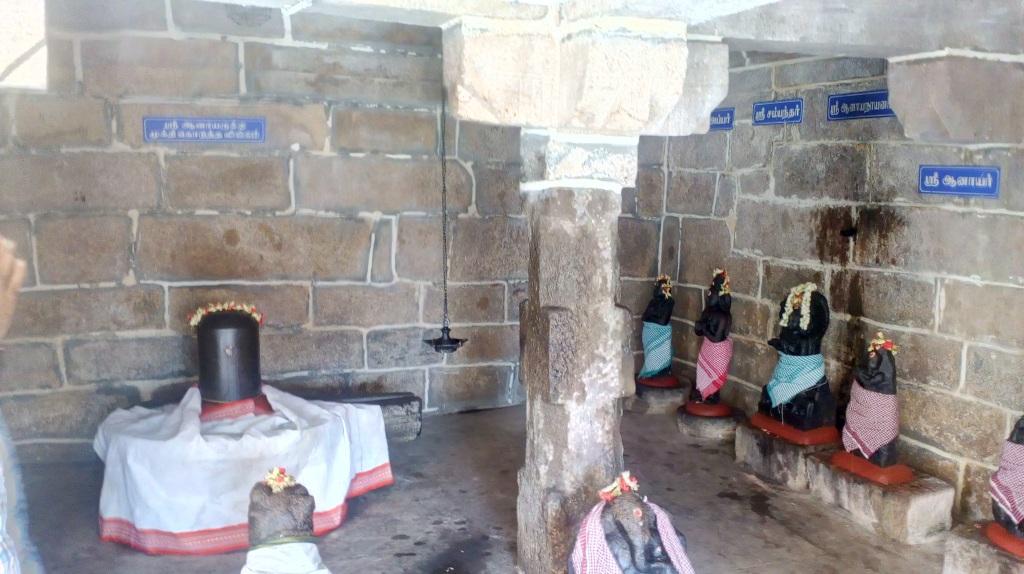
Shrines of Maha Ganapati, Shiva Linga that was worshiped by Parasurama, Gaja Lakshmi, Amman who granted Mukti to Anaya Nayanar, and Chandikeswara can be found in the prakaram. Idols of Anaya Nayanar, Shiva Linga who granted Mukti to Nayanar along with Nandi, Chandikeswara, Bana Linga, Appar and Sambandhar can be found in the prakaram. The Lingam that is supposed to have given Mukthi to Anaya Nayanar is said to be growing.


Theertham associated with this temple are Gaya Phalguni and Parasurama Theertham. Sthala Vriksham (Holy tree) is Jack Tree. The earliest inscription, of the fifth year Rajakesarivarma (Rajaraja I, A.D.990) registers a gift of gold by Karuvur kandali, apattakila (headsman) of Nagapattinam. An inscription dated to 15th year (A.D.1000) records a gift of land by Sembiyan Mahadevi. The temple was therefore built before A.D.990.