Showing posts with label UNESCO World Heritage Sites. Show all posts

Tuesday, October 8, 2019

Bas Relief Panel of Elephants, Peacock and Monkey, Mamallapuram, Chengalpattu

Bas Relief Panel of Elephants, Peacock and Monkey, Mamallapuram, Chengalpattu
Bas Relief Panel of Elephants, Peacock and Monkey is situated at the back side of  Trimurti Cave Temple, located in Mamallapuram Town in Chengalpattu District of Tamil Nadu. The rear side wall of the Trimurti Cave Temple has a beautiful bas relief panel where two elephants and their cubs along with a monkey and peacock are found. The family of elephants were depicted in the lower part and the realistically-carved peacock and monkey are found a little above.


Connectivity
For brief details, please refer below link;

Adi Varaha Temple, Mamallapuram, Chengalpattu

Adi Varaha Temple, Mamallapuram, Chengalpattu
Adi Varaha Temple is a Hindu Temple dedicated to Lord Vishnu located in Mamallapuram Town in Chengalpattu District of Tamil Nadu. This ancient cave temple is situated at the northern end of the main Mamallapuram hill, on its western side. This temple predates the Kadal Mallai Divya Desam in Mamallapuram and is one of the two Vishnu temples that have survived ravages of the sea over a millennium. The famed Avatara inscription found in this temple, which places a floruit on the Buddha as the ninth Avatara of Vishnu, is dated to mid-7th Century.


This temple is in worship since its inception as evident from inscriptions found at the site. As the worship still continues, therefore entry of a foreign national was not allowed earlier and this is the reason that this temple was not described by the early European travellers. The fate of the temple has not changed in the modern times as well. As the temple is under worship, it is kept open only for a short period, in the morning and evening, during prayer times and for the rest of the time, it is kept closed. Due to this reason, many modern visitors and tourists skip the visit to this Temple.


Legends
For brief details, please refer below link;
History
This temple predates the Kadal Mallai Divya Desam in Mamallapuram and is one of the two Vishnu temples that have survived ravages of the sea over a millennium. Similar to the Varaha mandapa, both have been dated to the 7th Century Narasimha Varman I Era. Although it has later inscriptions belonged to Parameshwara Pallava about consecration of the temple, its style suggests that it was built earlier. The famed Avatara inscription found in this temple, which places a floruit on the Buddha as the ninth Avatara of Vishnu, is dated to mid-7th Century.


This temple is one of the best preserved and most complete specimens of the rock-cut architecture at Mamallapuram. The temple has been modified with extra structures, most probably during the sixteenth century CE when the town witnessed resurgence during the Vijayanagara period. A modern structure, in front of the temple, restrict the view to its original shrine.

The Temple
For brief details, please refer below link;
Inscriptions
For brief details, please refer below link;
Temple Opening Time
The Temple remains open from 08.00 AM to 12.00 Noon and 03.00 PM to 05.00 PM.
Festivals
On the full moon day in Maasi every year, the utsava deity, Gnanapiran, goes on a procession to the sea shore on a Garuda Vahana.  
Contact
Adi Varaha Temple,
Mamallapuram – 603 104
Chengalpattu District
Mobile: +91 98404 08755
Connectivity
For brief details, please refer below link;

Saturday, October 10, 2015

Tiger Cave, Saluvankuppam

Tiger's Cave, Saluvankuppam, Mamallapuram, Chengalpattu
Tiger's Cave is a rock-cut Hindu Temple complex located in the hamlet of Saluvankuppam near Mamallapuram in Chengalpattu District of Tamil Nadu. It gets its name from the carvings of tiger heads on the mouth of a cave which forms a part of the complex. It is also called as Yazhi Mandapam. It is a famous picnic spot for Chennai citizens mainly due to its proximity to the beach and open space surrounded by a lot of trees. There are no entrance fees, but there is a small parking fee. There are a few small stalls outside this venue, offering cool-drinks, tender coconut, etc. The temple is maintained by the Archaeological Survey of India (ASI).


History
The Tiger Cave is considered to be one of the Mahabalipuram rock-cut temples constructed by the Pallavas in the 8th century AD. The Tiger Cave is believed to have been built by Rajasimha Pallava. The discovery of an inscription on a rocky outcrop in the Tiger Cave complex in 2005 led to the excavation of a Sangam period Subrahmanya Temple close by.


The Cave
Tiger’s Cave is a unique cave shrine which is different in style from the other monuments of Mamallapuram. The south east facing structure is cut at a height of 6 feet from the ground level. The pavilion is closed on all three sides and a 4 feet deep and 6 feet high cavity is excavated in the front. There are stairs to reach the high raised platform. They are supported by lion parapets on either side. The two lion pilasters with a female rider on the rearing lion are important features of the site.


Around the central cell, a surrounding garland like arrangement of eleven yazhis (a mythological animal) is found. Interestingly, some scholars believe that this pavilion might have been used as a festival pavilion during Indira Vizha (festival of Indra). There are references about Indra Vizha in ancient Tamil books such as Silapathikaram. The south facing side of the rock has two big elephant heads and an unfinished horse.


The north facing side of the rock has a big lion with an unfinished figure carved in its stomach. Tiger's Cave is actually a misnomer as the site is full of lion figures and Yazhi figures and not tigers. The space has been neatly developed by ASI with lawns dotted by palm, casuarinas and other trees. The small hillocks and rocks offer a natural excuse for children and adults alike to climb and run around.


Connectivity
For brief details, please refer below link;

Sthala Sayana Perumal Temple, Mamallapuram, Chengalpattu

Sthala Sayana Perumal Temple, Mamallapuram, Chengalpattu
Sthala Sayana Perumal Temple is a Hindu Temple dedicated to Lord Vishnu located in Mamallapuram Town in Chengalpattu District of Tamil Nadu. The Temple is also called as Thirukadalmallai. The Temple is constructed in the Dravidian style of architecture. The temple is glorified in the Divya Prabandha, the early medieval Tamil canon of the Azhwar saints from the 6th – 9th centuries AD. It is one of the 108 Divyadesam dedicated to Vishnu, who is worshipped as Sthalasayana Perumal and his consort Lakshmi as Nilamangai Thayar.


The temple is believed to have been built by Pallavas with later contributions from Cholas, Vijayanagar kings and Madurai Nayaks. The temple is believed to be the birthplace of the Vaishnava Azhwar saint Bhoothathalvar. The temple is one of the 32 Group of Monuments at Mahabalipuram that are declared as UN world heritage sites, but unlike others that are maintained by the Archaeological Survey of India, the temple is maintained and administered by the Hindu Religious and Endowment Board of the Government of Tamil Nadu.


Legends
For brief details, please refer below link;
History
For brief details, please refer below link;
The Temple
For brief details, please refer below link;
Temple Opening Time
The Temple remains open from 7.00 a.m. to 12.00 a.m. and from 3.00 a.m. to 8.00 p.m.
Religious Practices & Festivals
For brief details, please refer below link;
Literary Mention
For brief details, please refer below link;
Prayers
It is the belief of the devotees that worshipping Sthala Sayana Perumal means worshipping Perumal in his Vaikunda itself directly. Majority of the devotees pray for the removal of obstacles in their wedding proposals. Devotees perform special abishek to Lord and offer vastras. All wishes of the devotees are said to be fulfilled here as the Lord is seen sleeping on the floor, on par with the devotees, who visit him.
Contact
Sthala Sayana Perumal Temple,
Mamallapuram, Thirukazhukundram Taluk
Chengalpattu District – 603 104
Phone: +91 44 2744 3245 / 2744 2183
Mobile: +91 94442 35284 / 98404 08755
Connectivity
For brief details, please refer below link;

Atiranachanda Cave Temple, Saluvankuppam, Mamallapuram, Chengalpattu

Atiranachanda Cave Temple, Saluvankuppam, Mamallapuram, Chengalpattu
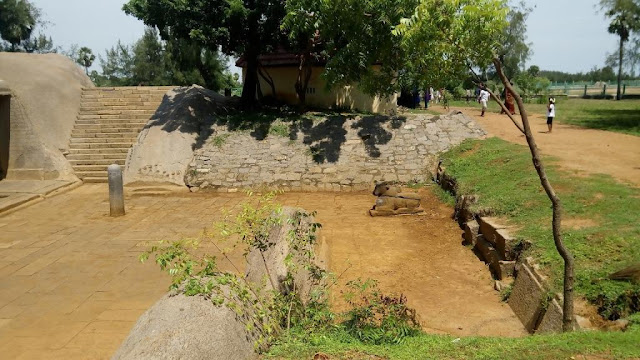
Atiranachanda Cave Temple is a rock-cut Hindu Temple complex located in the hamlet of Saluvankuppam near Mamallapuram in Chengalpattu District of Tamil Nadu. The temple is located below from the ground level. It is believed that this monument was built by Rajasimha Pallava. Atiranachanda Pallava is honorific title of Rajasimha Pallava. This Cave Temple is situated close to Tiger's Cave.


The Temple
This cave temple is very simple in its facade and resembles Pallava king Mahendravarman I Style. The Atiranachanda Cave Temple is east facing. The temple is located below from the ground level. Its layout is 28 feet (8.5 m)t in length and 6 feet (1.8 m) in width on plan, with a height of 6.5 feet (2.0 m). The façade carved on the rock face has two pillars and two pilasters, typical of Mahendravarman style, with an octagonal shaft with square base at the top and the bottom. The pilasters are tetragonal throughout.


The corbels of the pillars are curved and of roll-mouldings. Horizontal friezes in the form of mini shrines are also carved above the corbels, though incomplete. There are three chambers in the cavern with the central chamber being a square of 3.5 feet (1.1 m), whereas the other cells are integral to the wall. The cornice of the front facade has been left without usual decorations of dormer windows (kudu arches) and interconnected oblong shrines. Holes were made at the cornice to support a wooden mandapa in front at later point stage.


The central shrine is projected forward into the hall and provided with an entrance. On either side of the entrance, niches have been provided with help of pilasters. Dvarapalas are found in these niches. Both Dvarapalas rest one hand on a club while other hand is in Suchi mudra. There is bas relief of Somaskanda on its back wall inside the central cell. Shiva and Parvati are seated, while Skanda is in the lap of Parvati. There is a parasol above Parvati. Vishnu and Brahma are shown in upper corners. On either side of this central shrine, on the back wall, similar Somaskanda panels have been carved out, however these panels were left incomplete.


A granite multi-faceted, 16-sided, tantra-style Shiva Linga is placed in front of the Somaskanda panel in the central shrine. This type of black polished Linga is usually found during the reign of the Pallava King Rajasimha. However, it seems to be later addition in this cave, as the water outlet is provided after cutting off the lower part of the club of the right side dvarapala. There is another granite Linga installed in front of the temple. This is not part of the cave temple and is probably the only remnant of a free-standing temple. Nandi can be found facing the central shrine at the open courtyard.


Mahishasuramardhini Panel:
There is a magnificent panel depicting Durga as Mahishasuramardhini is carved out in front of the cave temple, on a separate boulder. Durga is shown with six arms, carrying bow, shankha (conch), chakra (discus), khadga (sword). She is shown alighting her mount, lion. Her army is already in process of annihilating the demon army, the chief of which, Mahishasura, is shown in anthropomorphic form with the head of a buffalo. Mahishasura is already in process of retreat where he and his army are being chased by the gana army of the goddess. This panel would certainly be among the best specimens of Mamallapuram for its aesthetic, dynamic and vivid portrayal of the fight scene.


Inscriptions
There are four inscriptions found in this cave temple. The temple contains an identical, 16-line Sanskrit inscription in two scripts: the South Indian Grantha alphabet on the south wall and the North Indian Nagari script on the north wall. Two small label inscriptions are found at the entrance of the cave. On the floor, there is another inscription from Chola (Rajaraja I) times - it records the gift of 90 goats for a perpetual lamp in the temple - in this inscription the town is mentioned as Tiruvizhichchal.


Connectivity
For brief details, please refer below link;