Friday, February 8, 2019

Avalanche Lake, Ooty, Nilgiris

Avalanche Lake, Ooty, Nilgiris
Avalanche Lake is situated near Ooty Hill Station in Ooty Taluk in Nilgiris District of Tamilnadu. Avalanche is just a 22 Kms drive from Ooty across sylvan surroundings. The scenic path meanders through the emerald camp and provides a magnificent view of the Avalanche valley and the Dam. The sparkling water of Avalanche Lake is wedged between dense woodland of shola trees.  Rhododendrons run a riot of colors in Avalanche, the magnolias bloom bright and the orchids are delightfully mysterious. 

The lake is a heaven for nature lovers, as small waterfalls falling down from the encircling mountains creates a picture-perfect ambience. This lake is the major source of water supply for the Kundah Hydro Power stations. The Lake is also famous for trout fishing. It also has arrangements for hiring fishing rods and other necessary Equipments. The surroundings of the dam are considered as a sanctuary with variety of wildlife and offers beautiful experience to visitors in the lap of nature.

Etymology
The lake derived the name avalanche because of a huge land slide (avalanche) that occurred in the region in the early 1800s.

Tourism
Avalanche Lake is an important tourism destination in the Nilgiris district. The lake is surrounded by a rolling landscape with blooming flowers like magnolias, orchids and rhododendrons. Tourists can traverse beside the lake through winding paths around the lake. Tourists visiting the lake can also engage themselves in Trout fishing. A trout hatchery is established near the lake, from where visitors can get fishing rods and other fishing accessories required for trout fishing. Permission from the Fisheries Department is required to go on fishing experience.

The lake is also used by tourists as a camp site wherein they pitch tents near the lake. Other tourist activities in the area include rafting across the lake and trekking the nearby hilly regions like Upper Bhavani where there are thick forests and untouched wild habitats. Over 2700 species of flowering plants, 160 species of fern and fern allies, countless types of flowerless plants, mosses, fungi, algae, land lichens are found in the sholas of the Nilgiris.

Sholas are patches of stunted evergreen tropical and subtropical moist broad leaf forest found in valleys amid rolling grassland in the higher montane regions, the shola and grassland together form the shola-grassland complex or shola-grassland mosaic. In terms of this broader definition, shola forests are found all along the upper reaches of the Western Ghats where the elevation goes beyond 1500 msl. This area lies in Kundah Reserved Forests comprising two Forest Ranges namely Udhagai South and Korakundah Ranges.

Avalanche and its surrounding areas get around 5000 mm of rainfall annually. There are some popular peaks in this region. Kolaribetta is the highest peak in this part with a height of 2,625 metres (8,612 ft.) where Doddabetta Peak, 4 kms away from Ooty with a height of 2,637 metres (8,652 ft.) is the highest point in the Nilgiris. Other major peaks in the Nilgiris are Mukurthi Peak 2,556 metres (8,379 ft.) and Nilgiri Peak (height: 2,477 metres (8,117 ft.).

There is jeep track for 3.5 Kms to the peak which was made to facilitate installation of a microwave tower atop Kolaribetta peak. This path is just off the road between Avalanche and Lakkidi Lake. A slightly shorter cross country route leads from the Bhavaniamman temple midway. A typical Nilgiri Red Rhododendron can be seen in the foreground. It is commonly called as Pongal Pooh because it blooms around the Pongal festival in mid-January.

Avalanche is a habitat of Wild animals like Tiger, Leopard, Gaur, Nilgiri Tahr, Sambar Deer, Sloth Bear, Barking Deer, Nilgiri Langur, etc., The Avalanche dam is also called as Canada Dam because Canada funded it. It is near to the Emerald Lake. The Avalanche Lake is also one among the major source water supply for the Kundah Hydro Power stations. Apart from the lake, there is also a Tribal Museum nearby, and also some beautiful stretches of tea estates.

Visitors should note that as the lake is situated in the Nilgiri Biosphere reserve, prior permission is needed from the forest office in Ooty. Private vehicles are not allowed into the Sanctuary and visitors have to take Forest Department mini bus for a 2 hours ride into the Sanctuary, covering Lake, Bhavani Temple and Hydro power plant. The bus starts from Forest Department Check Post 3 Kms before the Avalanche Lake. The buses are run between 9 AM to 3 PM (2 hours ride) at specific intervals. It is advised to take the 9 AM bus to have better chances of wildlife sighting. Jeeps are also available for a group of 8 people.

Accommodation
There is only the Forest Department guest house at Avalanche which you will need to book from the DFO office at Ooty. You will also need permission to visit Avalanche; you can go up to the Forest check post but not beyond without a permit.
Contact Details:
Nilgiris Wildlife and Environment Association 
C/o DFO (North), Mount Stewart Hill,
Ootacamand - 643 001
Phone: (0423) 2447167
Wildlife Warden, Ooty: Ph. (0423) 2444098
District Forest Officer (North): Ph. (0423) 2441950
District Forest Officer (South): Ph. (0423) 2444083
Connectivity
Avalanche Lake is located at about 22 Kms from Ooty, 22 Kms from Ooty Bus Stand, 23 Kms from Ooty Railway Station, 39 Kms from Coonoor, 52 Kms from Kotagiri, 71 Kms from Mettupalayam Railway Station, 105 Kms from Coimbatore and 117 Kms from Coimbatore Airport. Visitors should note that as the lake is situated in the Nilgiri Biosphere reserve, prior permission is needed from the forest office in Ooty. Private vehicles are not allowed into the Sanctuary and visitors have to take Forest Department mini bus for a 2 hours ride into the Sanctuary, covering Lake, Bhavani Temple and Hydro power plant.
The bus starts from Forest Department Check Post 3 Kms before the Avalanche Lake. The buses are run between 9 AM to 3 PM (2 hours ride) at specific intervals. It is advised to take the 9 AM bus to have better chances of wildlife sighting. Jeeps are also available for a group of 8 people. It is therefore best to arrive early and get the tickets, especially during peak season and holidays.

Annamalai Murugan Temple, Kundah, Nilgiris

Annamalai Murugan Temple, Kundah, Nilgiris
Annamalai Murugan Temple is a Hindu Temple dedicated to Lord Murugan in Kundah near Ooty in Nilgiris District of Tamilnadu. This Temple is also called as 7th Hill house of the Lord. Annamalai Murugan Temple offers a spectacular view of the surrounding region from the Temple site as it is set atop a hill offering an excellent vantage point.


Legends & History
A Saint named Krishnan was born as 8th child to poor farming couples in Kil Kundah. He was much devoted to Lord Murugan from his childhood. Suddenly, one day he disappeared from the Village. He went to Shivan Cave and undergone severe penance to have darshan of Lord Murugan. His penance continued for 3 years. It is believed that Lord Murugan gave him Darshan due to his intense penance and told him he was present in this place from time immemorial.


Even, he informed that this place was famous for Annadhanam. Lord Murugan informed his wish to continue Annadhanam and a Temple for him in this place to Krishnan. Though he was poor, he determined to fulfill Lord Murugan wish. He started collecting stones and arranging it on Hill Top. On seeing him, local villagers also joined him in the construction. Due to the Join efforts of Villagers, a beautiful Temple for Lord Murugan has been constructed in 1975 on the Hill Top.


The Temple
There is a shrine for Lord Vinayaga at the entrance of the Temple. Annadhanam Hall can be found to right of the Vinayagar Shrine. Sanctum housing the Bala Dhandayuthapani can be seen after crossing Annadhanam Hall on the right side. He is holding Dhandam in his hand. There are also shrines of Nagaraja and Navagrahas in the Temple premises. There is an observatory near Nagaraja shrine, from where the public can view magnificent panoramic views of Ooty and the Nilgiris. During Krthigai, huge number of devotees will visit and do special poojas to Lord Murugan. There is also a Cave temple located in the side.


Contact
Annamalai Murugan Temple,
Kil Kundah Post,
Nilgiris – 643 219
Phone: +91 423 250 9353
Mobile: +91 94423 42343
Connectivity
The Temple is located at about 5 Kms from Kundah Dam, 3 Kms from Manjur Bus Stop, 35 Kms from Ooty Bus Stand, 34 Kms from Ooty, 36 Kms from Ooty Railway Station, 37 Kms from Coonoor, 54 Kms from Kotagiri, 28 Kms from Kinnakorai, 62 Kms from Mettupalayam Railway Station and 96 Kms from Coimbatore Airport. The Temple is situated on Coonoor to Manjur Route near Kundah Dam. Manjur and Kundah is well connected to Ooty and Coonoor by Bus. Buses are available for every 30 minutes. Also, Buses (Morning and Evening) are available from Coimbatore to reach this Temple.  Private Taxis are available from Ooty and Coonoor to reach this place.
Location

Allathorai Falls, Kundah, Nilgiris

Allathorai Falls, Kundah, Nilgiris
Allathorai Falls is a Waterfalls located in Bikketti, a mountainous village in picturesque Nilgiris Hills near Ooty Hill Station in Kundah Taluk of Nilgiris District of Tamilnadu. Allathorai Falls is unknown to the tourists as it situated in the remote Village. No special permissions are required to reach this place. This Falls is ideal to visit during rainy season to enjoy the beauty of the falls to its extensiveness. The forest that surrounds this fall is home to numerous plants and animals so it would be a great place to visit for the wildlife enthusiasts. The volume of water will be great during the monsoons.


Dressing Restrictions: There aren’t any specific dressing restrictions and you may choose to wear clothes as per your convenience. It may also depend on the season of your visit.
Best time to Visit: The Best time to visit the falls would be between the months of September to May. The falls are at its best during the rainy season.
Visiting Timings: The timings to visit this fall are between 10 am to 6 pm. However, there are no specific time restrictions and you may visit it as per your convenience.
Entry Fee: There is no entry fee to visit this place.
Restrictions: There aren’t any restrictions on things you can take. You may carry food and water as per your requirement. It is advisable to carry fewer luggages as you may not find a suitable place to keep them.
Suggestions: These falls are a great place for hiking and trekking, so if you are in search of a good adventure, this is a great place to be. It is also a great place for photography.
Connectivity
Allathorai Falls is located at about 2 Kms from Kundah Dam, 5 Kms from Manjur Bus Stop, 29 Kms from Ooty Bus Stand, 29 Kms from Ooty, 30 Kms from Ooty Railway Station, 34 Kms from Coonoor, 51 Kms from Kotagiri, 30 Kms from Kinnakorai, 59 Kms from Mettupalayam Railway Station and 105 Kms from Coimbatore Airport. Allathorai Falls is situated on Coonoor to Manjur Route near Kundah Dam. Manjur is well connected to Ooty and Coonoor by Bus. Private Taxis are available from Ooty and Coonoor to reach this place.
Location

Thursday, February 7, 2019

Visvakudi Dam, Visvakudi, Perambalur

Visvakudi Dam, Visvakudi, Perambalur
Visvakudi Dam is located in Visvakudi Village near Veppanthattai in Perambalur District of Tamil Nadu. Visvakudi Dam is constructed across Kallar Odai Rivulet. The Dam is nestled between Vayalar hills and Semmalai. The reservoir can hold 30.67 million cubic feet of water. The dam is 615 metres long. There are two sluices and radial shutters were fixed on the two sluices.


Visvakudi Dam is located at about 3 Kms from Visvakudi, 9 Kms from Veppanthattai Bus Stop, 11 Kms from Esanai, 11 Kms from Vengalam, 19 Kms from Perambalur, 26 Kms from Valikandapuram, 30 Kms from Siruvachur, 48 Kms from Ariyalur Railway Station, 81 Kms from Trichy and 86 Kms from Trichy Airport.


Location

Valeeswarar Temple, Valikandapuram, Perambalur

Valeeswarar Temple, Valikandapuram, Perambalur
Valeeswarar Temple is a Hindu Temple dedicated to Lord Shiva located at Valikandapuram near Perambalur Town in Perambalur District of Tamil Nadu. Presiding Deity is called as Vaaleeswarar / Brahmapureeswarar and Mother is called as Valambigai / Bhrihannayaki. The Temple is situated on eastern banks of Koneri River. Arunagirinathar (15th century CE) has sung the praise of Lord Muruga of this Temple in his Thirupugazh Hymns.


Legends
For brief details, please refer below link;
History
Valikandapuram is an important city in the Chola Kingdom. The temple was built by the Cholas before the construction of Tanjore Brihadeeswarar Temple popular known as Thanjai Periya Kovil. The Temple has about 130 stone inscriptions including ones from the Chola period relating to Aditya Chola I, Parantaka Chola and Rajaraja Chola. Krishnadevaraya has contributed to the development of this temple.


Imperial Cholas allowed the popular merchant guilds to have their small band of army. Some of the famous trade guilds operated in medieval Southern India such as the Manigramam, Gatrigas, Nakaras, Mummuridandas, Ayyavole-500, Settis, Birudas, Settiguttas, Ubhayananadesigal, Biravaniges, etc. Valikandapuram is considered to be the birth place of Manigramam. Lot of inscriptions in this temple refers to donation of lamps to this Temple by this merchant guild. Hence this village would have been a busiest place in ancient trade.


The Temple
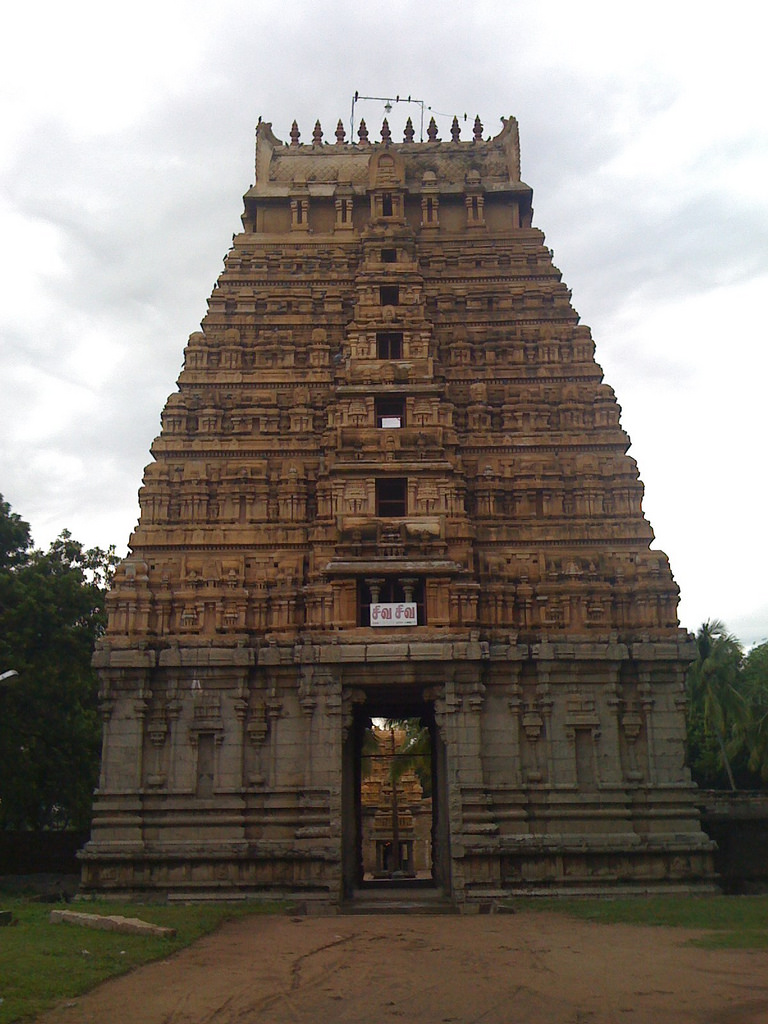
The Temple is having an imposing sever tiered Rajagopuram. Rajagopuram has stucco images of Europeans. Presiding Deity is called as Vaaleeswarar. He is called by this name during Kulothunga III period also. An inscription belongs to Kulothunga III attests this information. He is also called as Brahmapureeswarar. The Temple is abundant with Chola Era Inscriptions and intricate sculptures. He is housed in the sanctum in the form of Lingam. He is facing east.


There is a Lord Murugan idol in the precinct surrounding the sanctum. He is around 9 feet tall facing North. There is a Sahasra Linga opposite to the Murugan Idol. Mother is called as Valambigai / Bhrihannayaki. She is housed in a separate shrine. Her shrine is situated on the right side immediately after the Rajagopuram. Her shrine is facing south. Some dilapidated idols are kept in an open area opposite to Mother Shrine. This Temple got destructed by Nawabs during 18th Century. These idols might be result of this destruction.


There are three Nandhis namely Bala Nandhi, Vaaliba Nandhi and Yavana Nandhi located in series facing the Sanctum. Bhairavar with Naga around his waist in standing posture facing west can be seen in the Mahamandapam. Dwalabalagars can be seen at the entrance of Artha Mandapam. Shrine of Kalyana Vinayagar is located at the right side on entering Artha Mandapam. Sanctum is located after crossing Bala Nandhi.


Kuthirai Mandapam of this temple is of great beauty. It is also called as Natarajar Mandapam as it houses the Nataraja Idol. Also, it houses various pillars depicting dance postures, Yali and Horsemen riding horses. It was built during Krishna Devaraya Period. Similar type of Mandapams can be seen in Srirangam, Thiruvannamalai, Kanchipuram, Vellore and Chidambaram Temples. Bala Ganapathy is housed in a small stone mandapam located opposite to Rajagopuram and to the south of Natarajar Mandapam.


Saravana Theertham is located inside the temple premises on the right-hand side immediately after Rajagopuram. Theppam Festival is celebrated annually in this Theertham during olden days. A sculpture depicting Vaali worshipping Shiva can be seen in the Pillars located near the Theertham. Legend of Vaali has been depicted in the Pillars of the Temple. Koneri River flowing nearby is also considered as Theertham associated with this Temple.


Temple Opening Time
The Temple remains open from 06.30 AM to 11.00 AM and 04.30 PM to 07.00 PM.
Festivals
Adi Kirthikai and Tirukarthikai are celebrated grandly for Lord Murugan of this Temple. All Shiva related festivals are celebrated here. Monthly Pradoshams are observed here with reverence.
Singers
Arunagirinathar (15th century CE) has sung the praise of Lord Muruga of this Temple in his Thirupugazh Hymns.
Connectivity
The Temple is located at about 1 Km from Valikandapuram Bus Stop, 7 Kms from Ranjankudi, 11 Kms from Perambalur Bus Stand, 13 Kms from Perambalur, 17 Kms from Siruvachur, 18 Kms from Tholudur, 39 Kms from Ariyalur Railway Station and 72 Kms from Trichy Airport. The Temple is situated on Trichy Chennai National Highway between Perambalur and Thozhudur.

Valeeswarar Temple, Valikandapuram – Legends

Valeeswarar Temple, Valikandapuram – Legends
Vaaleeswarar:
Vanara King Vali worshipped Lord Shiva of this Temple and hence the Lord came to be called as Vaaleeswarar and Mother came to be called as Valambikai. Even, Koneri River flows nearby was called as Vaali Nadhi and Vaali Theertham. It is believed that Vanara King Vaali created this City during his rule and hence it is called as Valikandapuram.
Brahmapureeswarar:
As per Sthala Purana, Lord Brahma consecrated Shiva Linga on the banks of Koneri River and worshipped him to get darshan of Lord Shiva. Hence Lord Shiva is also called as Brahmapureeswarar. The Village was called as Brahmapuri and Koneri River was called as Brahma Theertham because of its association with Lord Brahma.
Koneri River:
Pancha Pandavas lived here during their Vanavasa by hiding their identities and worked under Virada king who ruled this area. During this time Dharma played dice game with the king and found that the king was indulging in foul play so Pandavas got angry and was about to pick fight with the King. Due to their compulsion of hiding their identities they kept calm and took bath in the river and worshipped Lord Shiva here to get rid of their anger. Hence the river calmed down their anger, river is called as Koneri River. Hence Virada ruled over this area, area is called as Ladapuram. Presently Ladapuram is located to the west of Valikandapuram.
Kandeeram:
During Sangam Age, this place was ruled by Velir king Kandeerakko and hence it is called as Kandeeram. Later on, due to its association with the legend of Vaali, the name of this place has been changed to Valikandapuram.
Suthamallan Jayamkonda Chozha Vannattudaiyan blessed with male child by praying to Lord Shiva here:
In olden days, this place was ruled by Suthamallan Jayamkonda Chozha Vannattudaiyan. He was not having heir to rule his kingdom. He prayed to Lord Vaaleeswarar sincerely for Child. He was blessed with male child by the grace of Lord Shiva. He endowed this Temple with revenues from Pugazharai Village. This incident was recorded in one of the inscriptions in this Temple.