Friday, September 28, 2018

Govindaraja Perumal Temple, Chidambaram – Connectivity

Govindaraja Perumal Temple, Chidambaram – Connectivity
The Temple is located at about 1.5 Kms from Thillai Kali Amman Temple, 9 Kms from Bhuvanagiri, 14 Kms from Pichavaram, 14 Kms from Achalpuram, 20 Kms from Sirkazhi, 25 Kms from Kattumannarkoil, 26 Kms from Vaitheeswarankovil, 44 Kms from Cuddalore, 65 Kms from Puducherry and 216 Kms from Chennai.
By Road:
The Temple is located at about 1.5 Kms from Chidambaram Bus Stand and 42 Kms from Cuddalore Main Bus Stand. Chidambaram is well connected to Cuddalore, Puducherry, Nagapattinam, Tindivanam, Chennai, Villupuram, Neyveli, Vadalur and Mayiladuthurai. Buses every 15 minutes from Madras via Tindivanam, Cuddalore – one can reach in about 5 1/2 hours. By car, one can reach Chidambaram in under 4 hours from Madras via East Coast Road.
By Train:
The Temple is located at about 2 Kms from Chidambaram Railway Station and 38 Kms from Cuddalore Port Railway Junction. Daily trains are available from Chennai Egmore to Chidambaram including a day express.
By Air:
The Temple is located at about 68 Kms from Puducherry Airport and 212 Kms from Chennai Airport.

Govindaraja Perumal Temple, Chidambaram – Literary Mention

Govindaraja Perumal Temple, Chidambaram – Literary Mention
The temple is glorified in the Divya Prabandha, the early medieval Tamil canon of the Azhwar saints from the 6th–9th centuries AD. It is one of the 108 Divyadesam dedicated to Vishnu. Thirumangai Alwar and Kulasekara Alwar has sung hymns (Mangala Sasanam) on Lord Vishnu of this Temple. Thirumangai Alwar had sung 32 Paasurams and Kulasekara Alwar had sung 11 Paasurams.
Thirumangai Azhvaar’s praise:
Thirumangai Alwar found Govindaraja to be still like a portrait or picture enchanting himself in the stunning dance of Lord Nataraja here at Ponnambalam - Chidambaram. So, among the 32 Paasurams he composed, the first 10 are of the Sankarabharanam Raga.  Sankarabharanam Raga is the favourite raga of Lord Shiva.
“Don’t take the pain of performing penance for long years by eating fruits alone, suffer under speedy winds or stand amidst five types of fire for the grace and darshan of Lord. Simply keep Lord with Mahalakshmi in his chest in your thoughts, go to Thillai Tiru Chitra Kudam, where his temple exists with sounds of Vedic Mantras and smoke of sacred Yajnas”, says Tirumangai Azhwar.
Thirumangai Azhvaar has praised, in his Paasurams, Nandivarma Pallava’s contribution to this temple.
“பையின் பொன்னும் முத்தும் மணியும் கொணர்ந்து
படைமன்வைன் பல்லவர் கோன் பணிந்து
செம்பொன் மணி மாடங்கள் சூழ்ந்து
தில்லைத் திரு சித்ரா கூடம் சென்று சேர் மின்களே”
Kulasekara Azhvaar’s praise:
Kulasekara Azhwar mentions this temple as Thillai Chitrakoodam and equates Chitra Kooda of the Ramayana fame with this shrine. Kulasekara Alwar considers Govinda Rajan as Sri Kalyana Rama and composed all his 11 Paasurams posing Govindaraja as Sri Rama only. Listening to Kulasekara Azhvaar’s praise of the Chitrakoodam Lord is equivalent to listening to the entire Ramayana.

Govindaraja Perumal Temple, Chidambaram – Festivals & Religious Practices

Govindaraja Perumal Temple, Chidambaram – Festivals & Religious Practices
The temple priests perform the pooja (rituals) during festivals and on a daily basis. As at other Vishnu temples of Tamil Nadu, the priests belong to the Vaishnavite community, a Brahmin sub-caste. The temple rituals are performed six times a day: Ushathkalam at 7 a.m., Kalasanthi at 8:00 a.m., Uchikalam at 12:00 p.m., Sayarakshai at 6:00 p.m., Irandamkalam at 7:00 p.m. and Ardha Jamam at 10:00 p.m. Each ritual has three steps: Alangaram (decoration), neivethanam (food offering) and Deepa aradanai (waving of lamps) for both Govindaraja and Pundarikavalli.
During the last step of worship, nagaswaram (pipe instrument) and tavil (percussion instrument) are played, religious instructions in the Vedas (sacred text) are recited by priests, and worshippers prostrate themselves in front of the temple mast. There are weekly, monthly and fortnightly rituals performed in the temple. The 10-day Chittirai festival celebrated during the Tamil month of Chittirai (March - April) and Gajendra Moksha festival are the prominent festivals celebrated in the temple. Vasantha Utsavam, Aadi Pooram, Panguni Uthiram, Chitra Pournami and Jestabishekam are the other festivals celebrated here.

Govindaraja Perumal Temple, Chidambaram – History

Govindaraja Perumal Temple, Chidambaram – History
This Perumal was installed by the Pallava King Nandhi Varman during 726 to 775 AD. The Govindaraja shrine is dedicated to Vishnu and is one of the 108 holy temples of Lord Vishnu called Divyadesam, revered by the 7th - 9th century saint poets of Vaishnava (those worshipping Lord Vishnu) tradition, Alwars. Kulasekara Alwar mentions this temple as Thillai Chitrakoodam and equates Chitra Kooda of Ramayana fame with this shrine. Parantaka Chozha is also said to have contributed to this temple in the 10th Century AD. King Kulothunga Chola II is believed to have uprooted the presiding Govindaraja image from the shrine. 
The shrine has close connections with the Govindaraja temple in Tirupati dating back to saint Ramanuja of the 11-12th century. Ramanujar fled to Tirupati with the Utsava (festival image) of the temple to escape punishment. In the 16th century, king Krishnappa Nayak was instrumental in installing the image of Govindaraja back in the temple. There was a lot of resistance from the Shaivites (those worshipping Shiva) against placing the Vishnu image in a revered Shiva temple, but the king was unmoved and the image was installed in the present form. 
There is no satisfactory evidence of co-existence of the Shiva and Vishnu shrines within the same temple built during the same time – there was a dispute in 1849 regarding the rights on the Govindaraja idol and Alwar Sannidhi (sanctum of Azhwars) between Vaishnavas and Dikshidars and the position of Vaishnavas was upheld by the district court. Some sources say that the deity was re-established at the original location in Chidambaram at much protest from the Dikshidars of the Nataraja temple. Other sources say that this deity was established in Tirumala, giving darshan at the present day Govindaraja Sannidhi.

Govindaraja Perumal Temple, Chidambaram – Legends

Govindaraja Perumal Temple, Chidambaram – Legends
Dance contest between Lord Shiva and Mother Parvathi:
Lord Shiva and Mother Parvathi offered a grand dance performance in Kailash when they were in a happy mood. At the end, they wanted to know the winner. They approached Lord Brahmma. He was not able to decide. They sought the opinion of Lord Vishnu. He suggested a stage be built by divine sculptor Vishwakarma for the dance contest. The contest began. For every type of Thandavas (dancing) Shiva did, Mother Parvathi too did her part thrillingly. They excelled each other. At the end, Lord Shiva simply lifted his right leg and kept it above his head which Parvathi could not. Lord Shiva was declared winner by Lord Vishnu. Lord Shiva stayed in this temple as Lord Nataraja and requested Perumal too to stay with him. Lord Vishnu is here in his reclining posture.
Brahma in Standing posture:
As a tradition, Lord Brahmma on the naval chord of Lord Vishnu is seen in a sitting form. Differing from this tradition, Brahmma is in a standing form in this temple. It is said that Brahmma chose to stand as a respect to Lord Vishnu who was to judge the winner in the dance competition taking place in the Chitra Sabha.
Place for Salvation:
Kaveran, the king of Kalinga had a daughter named Lopamudra married to Sage Agasthya. Sage changed Lopamudra as River Cauvery. Kaveran and his wife bathed in the river every day and asked their daughter, Lopamudra-Cauvery the means of attaining salvation. She advised them to go to Thillai Nagar and perform penance on Lord Vishnu to realize their wish and darshan of Lord. Pleased with their penance, Lord appeared with Mothers Sridevi and Bhoodevi and granted salvation to the couples.
Adisesha had darshan of Lord Shiva here:
Divine serpent Adisesha, serving as the bed of Lord Vishnu, desired to have the Thandava Darshan of Lord Shiva. Lord Vishnu sent him to have his desire fulfilled. Adisesha made friends with Maharshi Vyakrapada and had the darshan of Lord Shiva. He also had the blessings of Lord Vishnu here and returned to the milk ocean to resume his job as bed of Perumal. He has his shrine in the prakara at the feet of Lord Vishnu. It is believed that prayer to Adisesha would bring the dual benefit of the blessings of Lord Shiva and Lord Vishnu.
Thillai Nagar:
A demon woman Dhilli by name prayed to Lord Perumal to be a forest herself full of trees and that Lord should grace the place with his presence. She became Thillai trees. Named after her, the place came to be known as Thillai Nagar.
Akasha Sthalam:
Lord is looking at the sky as the place come under the Akash category.
Other Names:
This place is also referred to as Thillai Nagar, Chitrakoodam and Pundarika Puram.
Thiru Chitra Koodam:
The Mountain "Chitra Kooda Malai" was in North India. Lord Rama stayed in this place while he was sent to the forest. While he came searching for his wife who was taken away by Ravana, Lord Rama found this place in South India and compared its beauty to Chitra Kooda in North India. Thus, it got its name.
Lord Vishnu darshan to Sage Kanva & 3000 Dikshidars:
Legend has it that Govindaraja Perumal is believed to have descended for sage Kanvar and the 3,000 Dikshidar of the Thillai Natarajar temple.
Vishwakarma, Builder of this Temple:
It is believed that Vishwakarma, celestial sculptor built this temple.
Bharatha established Bharathanatyam here:
It is believed that Bharatha established Bharathanatyam here only.
Holy place:
Pancha Bootha became 5 Kalasas here in Thiru Chitrakoodam. 4 Vedha became 4 Gopurams. 36 Smritis became 36 entrances and 1000 names of Perumal became 1000 Pillar mandapam. Astakshara became the 8 steps to the main sanctum sanctorum.

Govindaraja Perumal Temple, Chidambaram – The Temple

Govindaraja Perumal Temple, Chidambaram – The Temple
The temple ranks among the 108 Divyadesams of Lord Perumal. The Temple follows Vaikanasa Agamam. As Lord Narayana poses as Nila Thingal Thundan Perumal having inside the Ekambareswar temple premises in Kanchipuram, here at Chidambaram Thillai Nataraja Temple, he poses as Govindaraja Perumal near Lord Natarajar Sannadhi. Presiding Deity is called as Govindaraja Perumal. Govindaraja Perumal's shrine faces east, while Nataraja's shrine faces south.

Lord Govindaraja is in a separate temple with his flag post in the temple known as Chitra Sabha. Perumal's shrine has its own circumambulatory passage and a set of towers. This shrine was renovated during the period of Vijayanagar rule. Standing in the front mandapam, the devotee can have the joint darshan of Lord Nataraja, Lord Govindaraja and Lord Brahmma on his naval chord simultaneously. This Shiva – Vishnu – Brahmma darshan is available for the devotees in this temple only.

Lord is in Bhoga Sayanam (Reclining Posture). Presiding Deity has Sangu and Chakram in his hands. He is accompanied by his consorts Sridevi, Bhudevi and Neela Devi at his feet. Adhishesha is seen with 7 heads and Perumal is wearing Salagrama Malai and Dasavathara Belt. Lord Brahmma with his four faces generally appears in a sitting posture on the naval chord of Lord Vishnu, here he appears in standing posture.

Of the Pancha Bhooda Sthalas – Space – Akash, Fire, wind, water and Prithvi the earth – this place belongs to Akash. Lord Perumal is facing Akash. The Vimana above the sanctum sanctorum is called Sadvika Vimana. Procession deity Devadhi Devan / Parthasarathy is in a sitting posture with Mothers. Another procession deity, Chitrakoodathullan, in a standing posture is with presiding Lord near his feet.

The speciality of this Temple is Lord can be seen in all postures. Utsava Idol Parthasarathy is in sitting posture, another Utsava Idol, Chitrakoodathan is in standing posture and Presiding Deity is in Sleeping posture. Mother is called as Pundarikavalli. Mother Pundarikavalli graces from a separate shrine. There is a shrine for Lord Rama can be seen in his Vanavasa Kolam (i.e poses as in his forest surroundings) in the Temple premises.

The Padukas of Lord are in a shrine in the prakara ensuring salvation to the devotees. Garuda Baghwan holding the devotee elephant Gajendra, Lords Narasimha, Venugopala and Maharshi Patanjali, Sri Andal and Sri Anjaneya also grace the devotees from their shrines in the prakara. There are also shrines for Chakkarathalwar, Udayavar, Narasimhar with Shanku chakram, Yoga Narasimhar, Koorathazhwar, Vishwaksenar, Alwars and Acharyas in the Temple premises.

In earlier days, there seems to have been separate temples for Vishnu and Shiva. This can be seen in Azhvaar’s praise of Thillai Chitrakoodam. There is said to have been a Nataraja temple known as Chitraambalam. Siru Ambalam signified that the Nataraja temple was small and Chitrakoodam (the Vishnu Lord) was the bigger temple. Chozha kings are believed to have destroyed the Vishnu temple and reconstructed the Nataraja temple and then positioned the Vishnu temple inside. 

There are 12 Theerthams associated with this Temple. It is believed that Visvakarma created 12 Pushkarini here in Chitrakoodam and they are Pundareega Saras, Amudha Koobam, Thiruparkadal, Shesha Theertham, Cauvery Theertham, Garuda Pushkarini, Swedha Pushkarini, Iyambaga Seshana Theertham, Indhra Pushkarini, Agni Theertham Samy Theertham and Nirjara Pushkarini. Among them, Pundareega Pushkarini is the holiest Theertham. In the temple tank, Pundareega Pushkarini, on the northern side, fishes come out of the water and on to the ground to pick up eatables thrown in by the devotees.

Velikanda Nathar Temple, Palakkarai, Trichy

Velikanda Nathar Temple, Palakkarai, Trichy
Velikanda Nathar Temple is a Hindu Temple dedicated to Lord Shiva located at Palakkarai in Trichy City in Trichy District of Tamilnadu. Presiding Deity is called as Velikanda Nathar and Mother is called as Sundara Valli Ambal. 


This Temple is considered as one of the Pancha Bhootha Sthalams around Trichy City. There are Shiva temples for 5 elements of nature (Land, Water, Fire, Air, and Space) inside Trichy and they are:
·        Boologanathar Swamy Temple, East Boulevard Road
·        Velikanda Nathar Temple, Palakkarai
·        Naganathar Temple, Nandhi Koil Street
·        Kasi Viswanathar Temple, West Boulevard road
·        Kailasanathar Temple, Big Bazaar Street
Connectivity
The Temple is located at about 250 meters from Prabath Bus Stop, 2.5 Kms from Trichy Railway Station, 3 Kms from Trichy Fort Railway Station, 3 Kms from Trichy Town Railway Station, 3 Kms from Trichy Central Bus Stand, 3 Kms from Trichy Chatiram Bus Station and 7 Kms from Trichy Airport.
Location

Varahi Amman Temple, Trichy

Varahi Amman Temple, Trichy
Varahi Amman Temple is a Hindu Temple dedicated to one of Saptha Matha Varahi Amman in Mangal Nagar in Woraiyur locality in Trichy City in Trichy District of Tamilnadu. Varahi Amman Temple was founded by His Holiness Sri Varahi Dasaar Boopathi Swamigal. The Temple remains open 7.00 am to 10.00 am and 5.30 pm to 8.30 pm.


The Temple is located at about 1 Km from Linga Nagar Bus Stop, 3 Kms from Woraiyur, 7 Kms from Trichy Railway Station, 4 Kms from Trichy Fort Railway Station, 7 Kms from Trichy Town Railway Station, 6 Kms from Trichy Central Bus Stand, 5 Kms from Trichy Chatiram Bus Station and 12 Kms from Trichy Airport.
Location

St. Mary’s Cathedral, Trichy

St. Mary’s Cathedral, Trichy
St. Mary’s Cathedral is located in Melapudur neighbourhood of Trichy City in Trichy District of Tamil Nadu. This Church is popularly known as Mother of Good Health (Arockia Matha) Church. It is one of the oldest Churches in Tamil Nadu.


History
The Church itself was built by a Jesuit missionary Fr. Louis Carnier. It was on the 29th June 1841, on the occasion of the feast of the apostles St. Peter and Paul, Bishop Bernard Clement of Pondicherry dedicated the Church to St. Mary. The paintings in the roof depicting the martyrdom of holy men and women of were done by Br. De’ Noircourt between the years 1893 to 1898. Having served for more than 170 years, the diocese has decided to build a New Cathedral and the work has begun on the 15th August 2011.


The Church
The Cathedral parish had in its fold vast territory for its pastoral activities. It had more than 20,000 families. The parishes – Crawford, Edamalaipatty Pudur, Subramaniyapuram, Sembattu, Gundur, K.K. Nagar, Airport, Kallukukuzhi, Karunamandapam and Puthur were carved out of Cathedral parish for Pastoral reasons and concerns. 


At present the parish has 27 substations. The total Catholic families are 2,935, and the population nearly 12,000, and the non-Catholic population more than 250,000. The Parish Pastoral Council consists of 63 members among them 15 are executives and 4 are officials. Parish Financial Committee, consisting of 5 members, manages the financial transaction of the Parish.


Church Opening Time
The Cathedral is kept open every day for personal prayers and visitations from morning 5.00 am to 12.00 pm and evening 4.00 pm to 8.00 pm, Adoration Chapel at the basement will be kept open from 6.30 am to 12 pm and 4.00 pm to 8.00 pm.
Connectivity
The Church is located at about 250 meters from Melaputhur Bus Stop, 250 meters from Marsing Pettai Bus Stop, 2 Kms from Trichy Railway Station, 4 Kms from Trichy Fort Railway Station, 4 Kms from Trichy Town Railway Station, 2 Kms from Trichy Central Bus Stand, 4 Kms from Trichy Chatiram Bus Station and 6 Kms from Trichy Airport.
Location

Our Lady of Lourdes Church, Trichy

Our Lady of Lourdes Church, Trichy
Our Lady of Lourdes Church is a Roman Catholic Church devoted to Our Lady of Lourdes located near Thayumanavar Swamy Temple Teppakulam in Trichy City in Trichy District of Tamilnadu. The Church was built in the 1895 in the Gallo-Catholic design. The Catholic church is a replica of our Lady of Lourdes church in France. 


History
According to an article by Fr. A. Joseph S.J. in the Tamil souvenir magazine (available online) published to celebrate the church’s centennial (1896-1998), the rector Reverend Father Leo Barbier S.J., (1893-1903) was the first person to moot the idea of the church. He also credits St. Joseph’s College principal Joseph Pei (1884-93), with encouraging the Tirunelveli-born master mason Dhanam Savaritmuthu to take charge of constructing the Our Lady of Lourdes church.


The building work started after around two years of preparation, when Savarimuthu is thought to have first learned from the fathers how to read the plans and also incorporate Christian symbolism in the building. As an acknowledgement of his services, Savarimuthu has been buried in the crypt below the altar of the church. This honour is usually reserved for the priests who have served the Jesuit college and mission in the area.


In 1838, French Jesuit missionaries came to Madurai. The missionary Fr. Ferdinand Celle S.J. built the Gothic Sacred Heart church in Idaikattur, Sivaganga district in 1894, and is also thought to have had a role in the Trichy church. Some other nuggets of information from the article indicate that the church site was marshy and water-logged as it was situated in an ‘Agazhi’ (moat) meant to encircle the old Trichy fort.


The foundation was reinforced and raised by pumping concrete into granite-lined holes of 15-20 ft depth (also known as the open caisson technique). The 8 ft cross atop the steeple weighs 73 kilos, and also acts as a lightning conductor for the building. As many as 50 sharp nails on the cross prevent birds from soiling it. It was brought down and gilded in 1996 and reinstalled after three months.

A further search for the science behind the church’s construction leads us to the National Institute of Technology Trichy(NITT), where third-year students of the Department of Architecture had researched the building in 2002. Detailed hand-drawn pen-and-ink plates describe how the Our Lady of Lourdes church was built to reflect both the Gothic style of European structures and suit the local requirements for daily worship.

“Our Lady of Lourdes church shows the talent of Indian craftsmen; it shows that they could build any structure, no matter what the style, using local materials,”


Architecture
The Church of Our Lady of Lourdes, a hundred years old, is built within the St. Joseph’s College complex, in gothic architectural style (it is said that a Maistry from Tirunelveli, one Savarimuthu, was given intensive training in such construction by the missionaries so that he could supervise the building), the Church’s 200 ft tall spire is visible from a radius of 8 kms around it. The Church has not been a repainted outside as the administrators wish to preserve its antiquity.
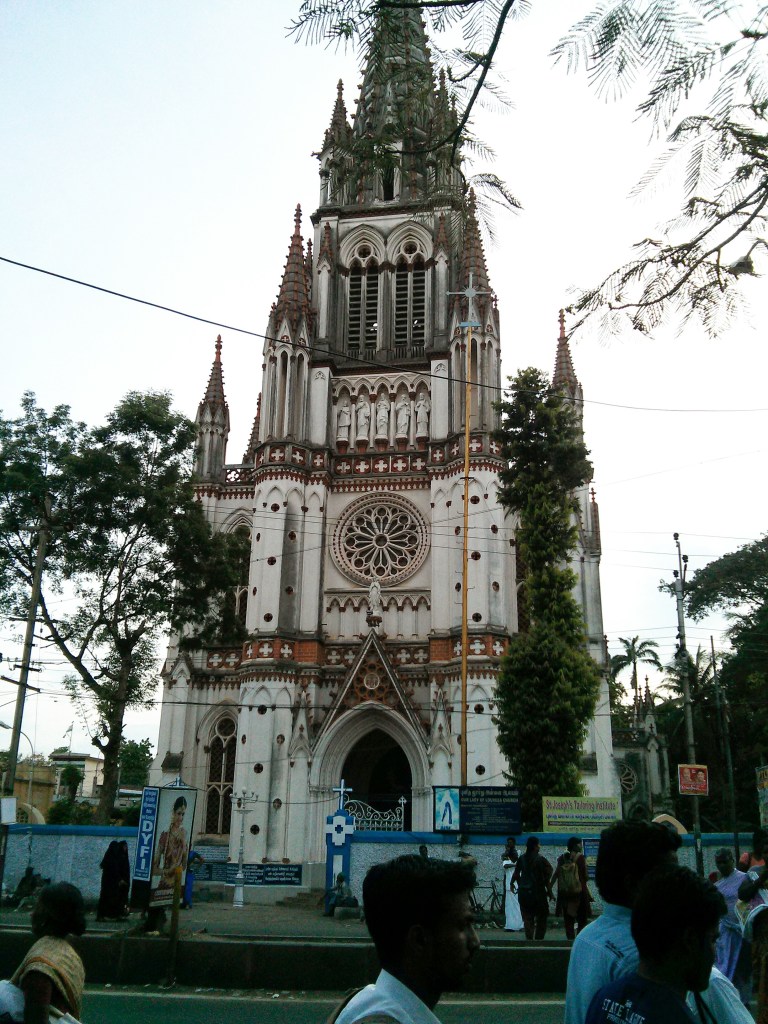

The stained-glass panels depicting stories from the Bible are truly beautiful. This hallowed church that forms an important land mark in this sprawling city was built in 1895 AD on the model of our Lady of Lourdes church – France. The church is decked out in Gallo-Catholic design, from neo-Gothic spires to anguished scenes of crucifixion and martyrdom painted inside. In a note of cross-religious pollination, icons of Virgin Mary are garlanded in flower necklaces.


The main tower is 220 feet in height, and the small tower is 120 feet in height. The statues of St. Sacred heart, along with St. Ignatius, St. Francis Xavier, St. Britto is placed at the center of the tower. The church bell is set at a height of 90 feet. This Gothic styled structure with pointed arch rises to a height of 62 feet above the nave right across the Main Guard Gate, which once formed the rampart of 'Trichinopoly' fort.


Inside this gate there is an old building called Clive hostel where Robert Clive of East India company stayed for a brief period. Massive walls, round pillars and topped arches are typical of the Norman style of architecture. The Church is a fine example of the blend of European and Indian sensibilities within the framework of Gothic architecture.


Festivals
The feast of Our Lady of Lourdes is held annually on 11 February.
Connectivity
Our Lady of Lourdes Church is located near to the famous St. Joseph College, Trichy Rockfort and Thayumanavar Swamy Temple Theppakulam in Trichy City. The Church is located at about 100 meters from Teppakulam Bus Stop, 400 meters from Trichy Fort Railway Station, 400 meters from Rockfort Bus Stop, 800 meters from Trichy Chatiram Bus Station, 5 Kms from Trichy Railway Station, 2 Kms from Trichy Town Railway Station, 5 Kms from Trichy Central Bus Stand and 9 Kms from Trichy Airport.
Location