Friday, December 28, 2018

Sowmya Damodhara Perumal Temple, Villivakkam – Festivals

Sowmya Damodhara Perumal Temple, Villivakkam – Festivals
Incarnation festival of Lord Vishnu is celebrated in the month of Chithirai (April-May). Gajendra Moksha (coming to the rescue of elephant Gajendra to save it from the clutches of a crocodile) festival is celebrated on the full moon day in the month of Aadi-July-August. Lord appears on his Garuda Vahana to save the elephant. On Makara Sankaranthi day-Pongal, falling almost on January 14 or a day before or after occasionally in some years, Lord appears as Raja Mannar as in Srivilliputhur with Mother Sri Andal, a darshan the devotee cannot afford to miss.
Reminding the Mohini Avatharam of Lord to teach a lesson to the proud sages of Tharukavanam, Lord appears as Mohini (an enchanting woman) in festival days in other Vishnu temples. This Alankara – dressing is offered to Mother in this temple in a festival on the fourth day in Thai month – January-February. Mother is seated in the garden of the temple on this day for darshan.
The birth star festival of the first three Alwars are celebrated for three days, while festivals for Periya Azhwar, Nammalwar, Tirumangai Alwar, Sri Ramanuja, Sri Desika are celebrated for 10 days. The festivals of Vaikasi Brahmmotsavam, Gokulastami, Navarathri, Pagal Pathu and Raappathu in the Margazhi month and Masi Magam float festival are celebrated with great joy at the temple. Apart from this, Panguni Uthiram, the wedding festival is celebrated in the temple.

Sowmya Damodhara Perumal Temple, Villivakkam – Legends

Sowmya Damodhara Perumal Temple, Villivakkam – Legends
Soumya Damodara Perumal:
The word Damodara is elaborately explained in Vaishnava philosophies. In short, it means that Lord can be controlled by pure love. During the childhood of Krishnavatara, He was terribly mischievous boy and Mother Yasodha could not bring him to order. She bound him by a rope, yet he moved with the rope in between two trees, broke them and granted salvation to two demons. The scar of the rope stayed on his waist deeply showing his willingness to be bound by a mother’s love. Damam in Sanskrit and Thambu in Tamil mean rope. Udharam means belly. The rope scar is around the belly, hence Damodara. Soumya means ever smiling and looking handsome. Hence, the name Soumya Damodara.
Damodhara in Tamil Literature:
The Last of Lord Narayana's 12 names mentioned in the "Dwadasa Nama Stotra" is Damodaran or the one who was bound to a grinding stone, known in Tamil as "Ural". The name has a special significance, according to Madhurakavi Azhwar, one of the Vaishnavite saints. He says in his Kanninunn Chiruthambu, his only work of 10 verses, forming part of the Nalayira Divya Prabhandham, that the Lord allowed himself to be bound to the grinding stone after playing for a long time with his foster-mother, Yasodha.
Another saint, Nammazhwar, mentions Damodara as the Lord of Brahma and Siva in his Thiruvaimozhi verse. Andal, the saint-poetess, in her Thiruppavai, goes one step further and says that Devaki, the mother of Lord Krishna, was purified by giving birth to him. But there are only a very small number of temples to the Lord with this name and one among them is the Sowmya Damodara Perumal Temple in Villivakkam. 
Sage Agastya digesting Vatapi:
Durvasa wanted to bring his sons-Vilvan and Vatapi – in the righteous and vedic path. However, their mother (one with asura qualities) was more inclined on the asura path. Angered at this, Durvasa left them and went to the forest. An upset mother sought revenge and wanted her sons to destroy the rishis. Taking up her orders, the two consumed one rishi after another. They would first play host to the rishi coming their way. During lunch, Vatapi would enter the rishi through the food they consumed. Once done, Vilvan would call out for his brother Vatapi, who would then tear open the rishi and come out. 
The worried rishis looked up to Lord Shiva for help, who directed them to Sage Agastya. Vatapi and Vilvan tried their prank on Agastya who came this way. After the Sage consumed the food, he digested Vatapi before Vilvan could call out for him in their usual planned way. Sage Agastya wanted Shiva and Vishnu to provide darshan at this place. Hence, at the Shiva temple, he is seen as Agastheeswarar. At the Vishnu temple, the Lord is seen as Sowmya Damodaran.
Villivakkam:
As the asuras were killed here, this place was referred to as Konnur. Later, this took the specific name of the two asuras- Vil (from Vilvan) and Va (from Vatapi) and came to be referred to as Villivakkam. This Kshetram came to be called Samhara Puri Kshetram.

Sowmya Damodhara Perumal Temple, Villivakkam – The Temple

Sowmya Damodhara Perumal Temple, Villivakkam – The Temple
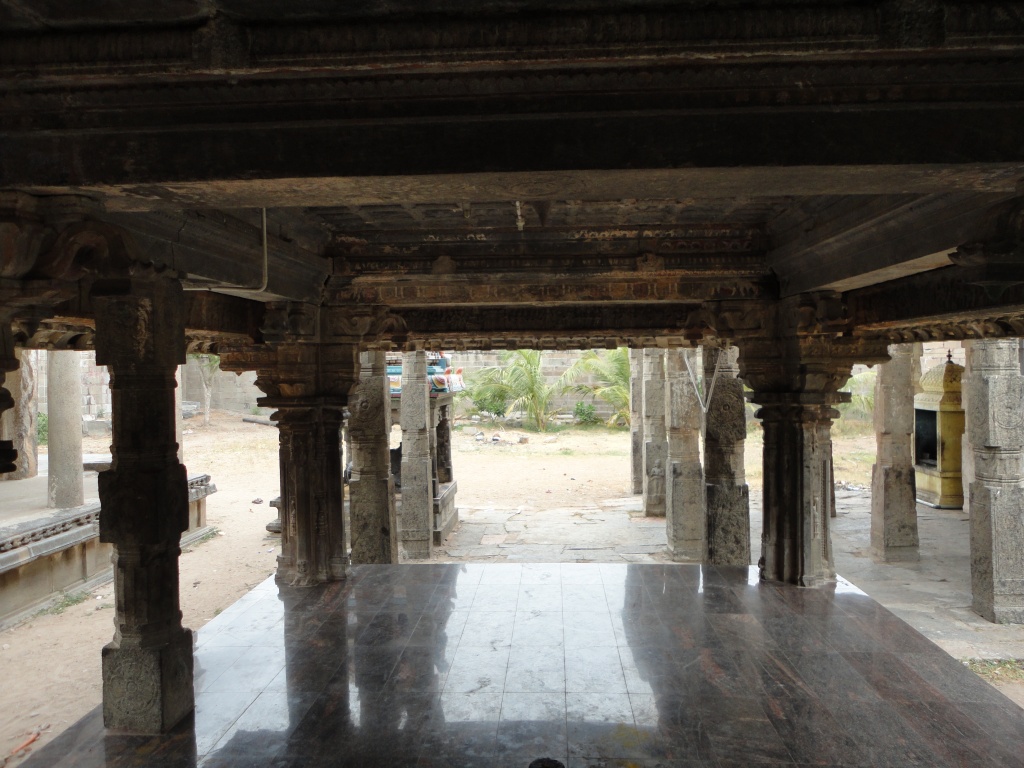
The temple is a sprawling complex with four big and four small Mada streets around it. The Temple is having three tiered Rajagopuram. It has got a beautiful garden on the right and the holy tank, known as Amirtha Pushkarani, on the left. The temple is a fine specimen of Pallava Style of Architecture. The area the temple and the tank is around 1.35 acres. It is in the four pillared Mahamandapam outside the temple where all festivals begin. 


Presiding Deity is called as Sowmya Damodhara Perumal and is facing east. He is housed in the sanctum gracing the devotees along with his two consort’s Sri Devi and Bhoo Devi in the standing posture. Presiding Deity and Procession Deity (Utsava Deity) has a scar in the stomach which is due to the rope tied by Yasodha. Devotees see the Lord only as Child Kannan. The Vimana (tower above the sanctum sanctorum) is Ananda Vimanam.


Garuda and Dwaja Sthambam are found opposite to the main sanctum. The idols of Nammazhvar and Ramanujar are seen on either of the sanctum sanctorum. Azhwars and Ganesha are found as niche images around the sanctum. Mother is called as Amirthavalli. She is found in a separate shrine to the right of the sanctum sanctorum in the corridor of the temple.


Having the attributes of Mother Mahalakshmi appearing from the nectar ocean, she is reverently named Amirthavalli. Amirtham means nectar. There are shrines for Rama and Krishna alongside the Mother Shrine. There is a separate shrine for Andal on the south side of the prakaram. The mandapams leading to the Thayar and Andal shrines have beautifully carved images. Interestingly huge fishes are found engraved on the ceilings.


There is a separate Anjaneya sannidhi near the main gate itself. There is a Nandavanam next to this sannidhi and a pond attached to the south side of the temple. The temple, having a big tank, Amirtha Pushkarini is believed to be built around 600 years back. As in Tirupati, the Amirtha Pushkarini sacred spring is in the north side known Kubera (Lord of Wealth) direction.


Friday, December 14, 2018

Swarnapureeswarar Temple, Koogaiyur, Salem

Swarnapureeswarar Temple, Koogaiyur, Salem
Swarnapureeswarar Temple is a Hindu Temple dedicated to Lord Shiva located at Koogaiyur Village in Salem District of Tamil Nadu. Presiding Deity is called as Swarnapureeswarar and Mother is called as Periyanayagi. This is one of the Pancha Bootha Sthalams installed by Vasishtar on the Northern banks of the Vasishta river representing the Sky (space) element. This Temple is considered as a Thevara Vaipu Sthalam. Thirunavukkarasar had mentioned about this Temple in one his hymns. This Temple is considered equivalent to Chidambaram Nataraja Temple.


Legends
For brief details, please refer below link;
History
The Temple was built in 7th Century AD. It was a brick structure. This brick structure was converted to granite structure by Ponparapina Rajaraja Kovalarayan on the orders of Kulothunga Chola III in 1184 AD.


The Temple
For brief details, please refer below link;
Temple Opening Time
The Temple remains open from 06.00 AM to 11.00 AM and 05.00 Pm to 07.00 PM.
Festivals
Chithra Pournami Car Festival, Aadi Pooram, Aadi Kiruthigai, Avani Chathurthi, Purattasi Navarathri, Aippasi Kanda Sashti, Aippasi Annabishekam, Karthigai Deepam, Margazhi Thiruvadirai, Arudra Dharisanam, Pongal, Tamil New Year, Thai Poosam, Masi Magam and Panguni Uthiram are the festivals celebrated here with much fanfare.
Prayers
People worship Lord Shiva for education and jobs. Also worship Lord to get relief from Navagraha Doshams. People pray to Bhairavar to get rid of fear, poverty and enmity. People pray to him with Ghee Lamp and Cashew Garland on Ashtami Days for Child Boon. Devotees also pray to Mother for clearing marriage obstacles.
Contact
Swarnapureeswarar Temple,
Koogaiyur, Salem District – 606 301
Phone: +91 427 240 0415
Mobile: +91 93450 65727
Connectivity
The Temple is located at about 300 meters from Koogaiyur Bus Stop, 10 Kms from Aragalur, 14 Kms from Chinnasalem, 14 Kms from Chinnasalem Railway Station, 20 Kms from Thalaivasal, 31 Kms from Kallakurichi, 35 Kms from Attur, 99 Kms from Salem, 113 Kms from Salem Airport and 248 Kms from Chennai Airport. The Temple is situated on Salem – Attur – Vridhachalam Route. Koogaiyur is situated at about 6 Kms from Chinna Salem Koot Road. There are lot of buses available from Attur, Thalaivasal and Chinna Salem visa Kuraal Village to Koogaiyur.

Swarnapureeswarar Temple, Koogaiyur – Legends

Swarnapureeswarar Temple, Koogaiyur – Legends
Swarnapureeswarar:
Once, Lord Guru visited Indra Loka to meet Lord Indra. Indra was arrogant and very busy in discussion with Devas. He did not respect Guru for a single instance. Lord Guru got angry and left Indra Loka. Indra Loka lost its pride without Lord Guru. Lord Indra too realized his mistake and searched for Lord Guru. Lord Guru was in formless form worshipping Lod Shiva amidst Amla forest in Koogaiyur. Lord Shiva gave darshan to Guru. At the same time, Lord Indra too reached the place and worshipped Lord Guru to forgive his mistakes. Since Lord Shiva gave darshan to Lord Guru, he is called as Ponparappina Eshwaran or Swarnapureeswarar.
Pancha Bootha Sthalams:
Daksha, father in law of Lord Shiva conducted Yagna without inviting Lord Shiva. Devas, Rishis and other celestial beings attended the Yagna. Lord Shiva got angry and demoted all of them from their divine posts. Later, on the advice of Suga Brahma Rishi, Saptha Rishis, particularly Sage Vasishta, installed Shiva Lingam on five places on the banks of Vasishta Nadhi and worshipped Lord Shiva. These five places are considered as Pancha Bootha Sthalams. This place represents Sky element.
Koogaiyur:
Once, this area was ruled by Koogai, Local Chieftain. Hence this place is called as Koogaiyur.
Koozhaiyur:
Thirunavukkarasar had mentioned this place as Koozhaiyur in his hymns. Later Koozhaiyur got corrupted to Koogaiyur.
Tirumular stayed in a cave here:
Tirumular had stayed in a cave (Kugai) here and undergone penance in the cave. Hence this place was called as Koogaiyur.
Lord Shiva brought back the life of the Son of a Sthapathy:
When the son of the Sthapathy of this temple died due to snake poison, the Lord of this temple came in the form a Siddhar and brought the life of the boy.

Swarnapureeswarar Temple, Koogaiyur – The Temple

Swarnapureeswarar Temple, Koogaiyur – The Temple
The Temple is situated on the North East of Koogaiyur Village. The Temple is facing west with five tiered Rajagopuram. There is 12 pillared Vasantha Mandapam immediately after Rajagopuram. Balipeedam and a big Adhikara Nandhi can be found after Vasantha Mandapam facing towards sanctum. Presiding Deity is called as Swarnapureeswarar. Lord is represented in the form of Lingam and is housed in the sanctum.


Lord is Swayambu Moorthy.  He is facing east. Nardana Ganapathy, Dhakshinamoorthy, Lingodhbava, Brahma, Vishnu and Swarna Durga are the Koshta Idols located around the sanctum walls. There are Idols of Suryan, Chandran, Karpaga Vinayaga, Subramanya, Chokkanathar and Chandikeswarar in the prakaram around the sanctum.


Mother is called as Periyanayagi. Mother shrine was situated in the northwest of first prakaram. Now she is called as Adhi Amman and gracing the devotees from this place. Later during Kulothunga Chola III period., a separate shrine was built for Mother Periya Nayagi. There is also 108 Lingams in here shrine.


There is Kubera Sthana Mandapam in from of Mother Shrine. It is famously called as Koogaiyur Kudangayazhagu. This Mandapam has been supported by four musical pillars. There are idols of Vinayagar, Lord Subramanya with his consorts Valli and Deivanai, Lord Vishnu with his consorts Sridevi and Bhoodevi, Aadhi Mahavishnu, Jyeshta Devi, Pradosha Nayagar and Nataraja in the Thiruchutru Mandapam.


There is a shrine for Bhairavar in this Temple. People pray to him to get rid of fear, poverty and enmity. People pray to him with Ghee Lamp and Cashew Garland on Ashtami Days for Child Boon. There is also a shrine for Navagrahas in the Temple premises. Sthala Vriksham is Amla Tree (Nelli Maram). Theertham is Vasishta River.


Tirusoolanathar Temple, Tirusulam, Chennai

Tirusoolanathar Temple, Tirusulam, Chennai
Tirusoolanathar Temple is a Hindu Temple dedicated to Lord Shiva located at Tirusulam, well-known locality of Chennai City in Tamil Nadu. Presiding Deity is called as Tirusoolanathar and Mother is called as Thirupurasundari.  The Temple is beautifully located amidst of 4 hills denoting 4 Vedas. It was re-built recently and Maha-Kumbabishekam conducted successfully.


Legends
For brief details, please refer below link;
History
For brief details, please refer below link;
The Temple
For brief details, please refer below link;
Temple Opening Time
The temple remains open from 07.00 AM to 11.00 AM and 04.00 PM to 08.00 PM.
Pooja Timings
·        Kalasanthi Pooja – (8:00 A.M)
·        Sayaratchai Pooja – (5:00 P.M)
Festivals
Chithirai Tamil New Year, Aadi Fridays, Vinayagar Chathurthi, Navarathri, Aipasi Annabishekam, Karthigai Deepam, Skanda Sashti, Karthigai Somavarams, Margazhi Thiruvadirai, Arudra Darshanam, Thai Poosam, Thai Fridays, Masi Maha Shivarathri, Panguni Uthiram and Monthly Pradoshams are celebrated here with much fanfare.
Contact
Tirusoolanathar Temple.
Tirusulam, Chennai – 600 043
Phone: +91 44 2264 2600
Mobile: +91 80560 50671 / 94447 64162
Connectivity
The Temple is located at about 1 Km from Airport Bus Stop, 1 Km from Tirusulam Bus Stop, 1.5 Kms from Tirusulam Railway Station, 1.5 Kms from Chennai Airport, 3 Kms from Meenambakkam Metro Station, 17 Kms from Chennai Mofussil Bus Terminus, 21 Kms from Chennai Central Railway Station, 20 Kms from Egmore Railway Station and 22 Kms from Chennai.
The Temple is located in Trisulam on the Guindy – Tambaram route, Chennai Suburb. The temple is located at about 3 Kms away from the main road. Take the road opposite to the Chennai Airport bus stop which passes through the railway level crossing and go around 3 Kms in the interior to reach the temple. Autos are available from Pallavaram, Airport & Tirusulam Railway Station.

Tirusoolanathar Temple, Tirusulam – History

Tirusoolanathar Temple, Tirusulam – History
This temple is said to have been built during the reign of Kulothunga Chola I, in the 12th century A.D. The walls of the temple have inscriptions from the Cholas and Pandyas. According to the stone inscriptions found in the temple, the place was called as Vanavan Maadevi Chathurvedhi Mangalam. The temple has big historical mysteries behind the walls. There is a story of a hiding place for precious metals and jewelry beneath the earth, where a secret path is said to exist. Kulothunga I Chola is said to have hidden treasures somewhere here, instead of inside the temple.
There exists a subway under the temple that connects the temple to the nearby hills known as "Panchapandava's Hills", where the king had his palace. In March 2018, there is four-member volunteer team Tirusulam Ilam Kalaiyar found a temple water tank near Tirusoolanathar Temple, which was filled with drainage water and dirty sands. After cleaning, they found an amazing well inside with a wonderful water to drink. There is another surprise is that the well inside Tirusoolanathar temple is connected to this tank.

Tirusoolanathar Temple, Tirusulam – Legends

Tirusoolanathar Temple, Tirusulam – Legends
Brahmapuri:
According to the legend, originally, Lord Brahma was 5 headed. As Lord Brahma was too proud of himself, Lord Shiva cut one of his heads off to bring down his ego. Later Brahma continued his duty of creation. He prayed Lord Shiva that he couldn’t concentrate on his duty because he was disturbed losing a head. Lord Shiva blessed him and granted peace of mind after which Lord Brahma continued his duties peacefully.
After this incident, as part of his duty, Lord Brahma created one of the most beautiful dancers of Devaloka, called Thilothama. After creating her, Lord Brahma himself fell in lust with her, because of her divine beauty. Lord Brahma went and spoke to her. Thilothama refused to accept him saying that as Brahma himself being her creator, he is in the position of her father and hence she can’t think of involving herself with him.
Knowing this, the Siva Ganas (Lord Shiva’s soldiers) started chasing Lord Brahma, to punish him for the sin he committed. Lord Brahma hid himself, amidst the hills in this place and also realized his sin. To be relieved off the sin, Lord Brahma installed a Shiva Lingam here and started worshipping Lord Shiva. Lord Shiva was pleased with his prayers apologized Lord Brahma as he realized and admitted his sin. As Lord Brahma, the creator worshipped Lord Shiva here; it was called as Brahmapuri originally.
Thirusoolam:
The temple is situated amidst 4 hills surrounding it. In Tamil, the place between the hills is called ‘Churam’ and hence this place was called as ‘Thiru Churam’ which had later become Thirusoolam. It is believed that these 4 hills denote 4 Vedas.
Trichuram:
The temple gets its name from Trichuram family which ruled over the region.

Tirusoolanathar Temple, Tirusulam – The Temple

Tirusoolanathar Temple, Tirusulam – The Temple
This temple is said to have been built during the reign of Kulothunga Chola. The temple is facing east with an entrance arch. Immediately after the arch, Dwajasthambam, Palipeedam and Nandhi mandapam can be found facing the sanctum. The base of the temple is about 3 feet below the ground level. Presiding Deity is called as Tirusoolanathar. Lord is a Swayambu Moorthy and is facing east. He is housed in the sanctum in the form of huge Lingam. The sanctum has been built in Gajabrushta or Thoongayanai Maadam shape.


Vinayagar, Veeraasana Dhakshinamoorthy, Lingothbavar, Brahma and Durgai are the Koshta Deities located around the sanctum walls. The Ganapathy is having a Naga Yajnopavita (Poonul) and is considered very auspicious. to remove obstacles especially for marriage and marital harmony. There is the Veeraasana Dhakshinamoorthy, as he is seen sitting in the ‘Veeraasana’ Posture, with his left leg folded and his right leg on the Muyalagan Asura. The Lingodhbava has a panel showing Vishnu worshipping Shiva. The Brahma and Durga are also very intricate.  


Mother is called as Thirupurasundari and is facing south. Mother Idol is about 5 foot tall. There is another deity of Thiripurasundari inside the main sanctum, just in front of the presiding deity. During a Muslim invasion, the original deity of Devi from outside the sanctum was damaged by intruders, thus the new Idol was installed in its place. A temple priest then dreamed that the Lord instructed him to place the damaged deity next to the main deity itself. So, the damaged deity of Devi found a place just next to Tirusoolanathar, and a new deity of his consort was placed outside the sanctum door.


There are shrines of Lord Srinivasan, Viswanathar with Visalakshi, Lord Murugan with his consorts Valli and Devasena, Arumugam, Muthu Kumaraswamy, 16 faced Markandeya Lingam (Shodasa Lingam), Naalvar, Natarajar Saba and Bairavar in the inner courtyard. Nandhavanam, Nagars under peepal / Bodhi tree, Vahana Mandapam, Urchava Mandapam and Navagrahas can be found in the outer courtyard.


Lord Aiyappan and Adhi Sankarar Shrines can be found on the North-east corner of the sanctum sanctorum in the outer courtyard. There is a rare Sarabeswara with two faces carved on the pillar in front. The Sthala Vriksham is the Vilvam Tree. Theertham associated with this Temple is Brahma Theertham. The walls of the temple have inscriptions from the Chola period.